We’ve recently announced Birdaro, a new project to support leaders of open-source projects as they consider whether to scale their projects and what sustainability pathways they might follow. Birdaro will be building on previous work CSCCE has carried out into the common human infrastructure challenges that can affect open-source projects – topics such as how a project can successfully engage a community, how and when to define clear roles and decision-making processes, and how to remain open to a range of contributions while striving to be inclusive and safe.
In this post, we’ll share some of our earlier work on the NSF Pathways to enable Open Source Ecosystems (POSE) program, from which we derived a working model of five key themes important to project scaling. We’re sharing the model as a way of grounding the focus of some of Birdaro’s future activities and as a starting point for conversations about how we might collaborate on addressing these topics.
It’s also worth noting that in sharing the background to this model (and other things we’ve published recently such as our CEF evaluation report) we’re also starting to make more visible some of the approaches that we take to curriculum development for our trainings. You can expect more on this topic in the future.
Background
Back in September 2022, we received funding from the NSF POSE program to develop a pilot training program for their grantees. The training was intended to offer project leaders support in advancing the skills they would need to transform their open-source project into a sustainable community-centric ecosystem (NSF terms these “Open Source Ecosystems, or OSEs).
As with all of our curriculum development projects, we took a human-centered design approach and started with a research phase to inform what we created (Figure 1). In this instance, we conducted a needs assessment to gain a better understanding of the specific challenges that scientific open-source projects face when considering how to scale and sustain their projects.
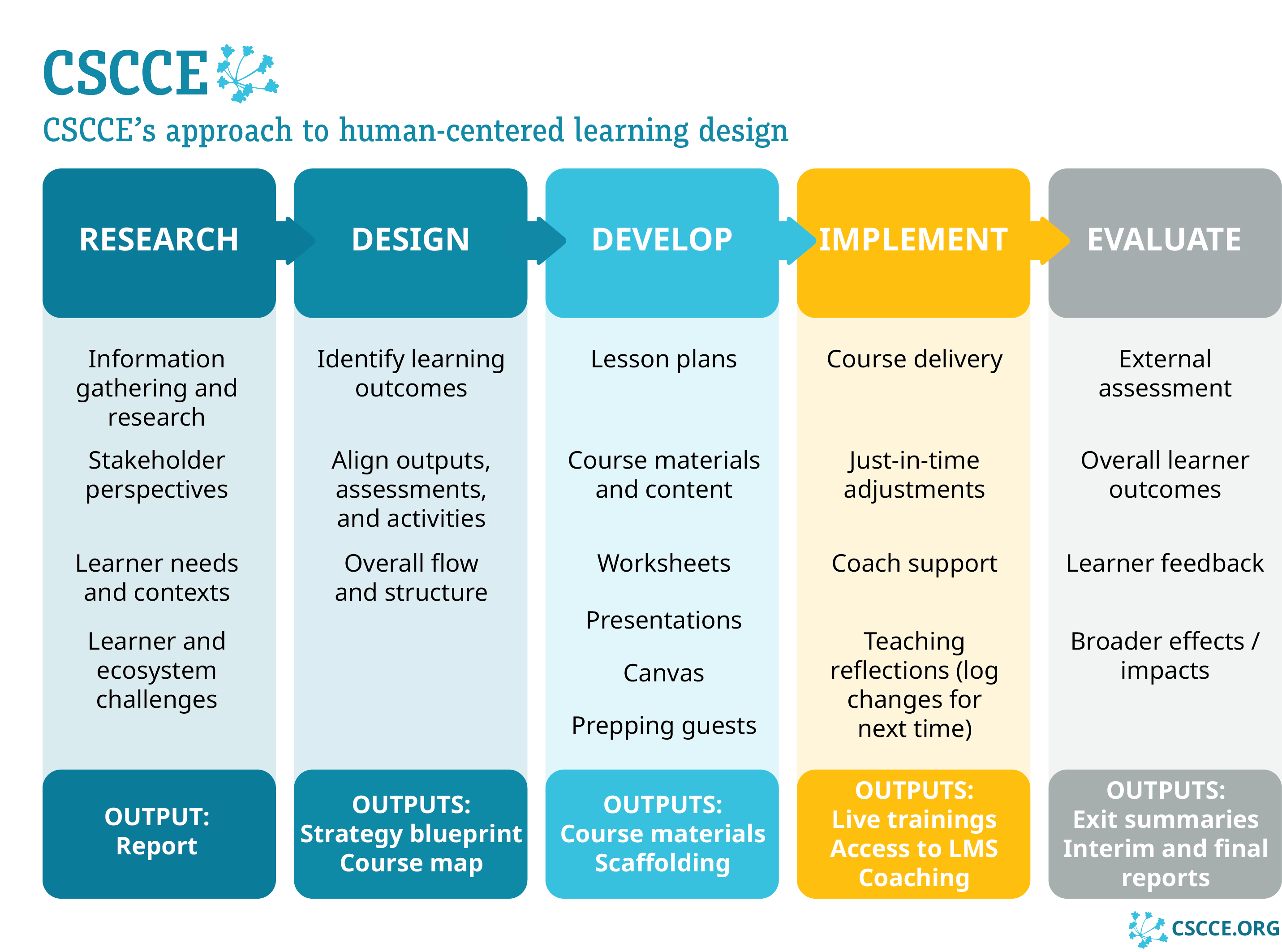
Figure 1: CSCCE follows a human-centered design approach to curriculum development using a model closely related to the ADDIE model developed in the 1970s as part of a collaboration between the Center for Educational Technology at Florida State University and a branch of the U.S. Army.
The needs assessment involved 30-45 minute interviews with the six NSF program staff associated with the POSE program and the six members of a steering committee selected by NSF. We used a standard set of questions for each group and asked specifically about the challenges projects were expected to face and for any associated considerations about what any training would need to address in order to be effective. We also asked additional questions about the potential impact of training on the wider open source ecosystem that we may return to discuss later.
Through analysis of the interview responses, we identified five key themes related to open-source: governance; organizational management; community engagement; systems-health considerations; and business skills. Here, we will first introduce these themes and then describe how we might think about the relationship between them.
Five themes in OSS project scaling
Theme 1: Governance
The theme of governance was the most frequently cited in our interviews, and was often the first topic to be mentioned. One common observation was that an essential component of governance is having a clearly articulated and robust process for decision making, and that ultimately the founder(s) of a project should be looking to cede their role as a “benevolent dictator” (BDFL, https://en.wikipedia.org/wiki/Benevolent_dictator_for_life) to make way for additional, clearly-defined, roles and accompanying processes. This will likely include acknowledging that as a project scales, consensus-building becomes unrealistic for every decision, yet without agreed upon processes delegating and/or shifting to other modes runs the risk of losing the trust of the original team, or creating confusion about who to involve in a specific decision.
Several interviewees noted that outlining governance is as important for engaging the core project team hosting the project (who may or may not be paid) as it is for managing volunteer contributions. With volunteers, the role of governance includes setting clear expectations about how volunteers can contribute to the project, and defining the factors that determine whether work is acceptable (such as outlining the process for reviewing and merging pull requests). Given that disagreements may arise, some clarity about how to address them so they don’t become overly time-consuming is likely also needed as projects scale. One disagreement every few months may feel manageable – but “catastrophic success” in terms of multiple people enthusiastically engaging and potentially disagreeing can quickly exhaust limited human infrastructure resources such as maintainer time.
It is also important to think strategically about how governance decisions will support building trust within the community, which is where this theme overlaps with the community engagement theme. The project team should lead with inclusive practices, cede control when appropriate, and keep community members engaged and motivated throughout the decision making process. To support this, robust codes of conduct and conflict resolution processes will need to be developed and socialized, and pathways to community leadership roles will need to be created. Relatedly, outlining how contributions to the project will be recognized can help to elevate different roles.
Finally, governance will likely continue to evolve as a project does and remaining responsive to that requires ongoing reflection and iteration.
Training focusing on this theme might include: defining roles inside and outside the core team, creating leadership pathways and ways of recognizing contributions, delineating how decisions are made, creating codes of conduct, plans for conflict resolution, and community health metrics.
Theme 2: Organizational Management
As they start to grow, many OS projects begin to consider what an appropriate organizational home is for their project – whether that’s aligning with a fiscal sponsor, forming their own non-profit or for-profit, and/or building or expanding academic and industry partnerships. Similar to establishing governance, organizational management can help mitigate potential challenges as well as make it easier to receive and administer funds and/or support staff and volunteers. It also supports establishing clear roles and responsibilities of team members to ensure the work required for success is carried out effectively, even those more mundane tasks that team members may not be excited to engage in.
Training focusing on this theme might include: options for host organizational structures; team coordination and the role of playbooks; project lifecycles and the corresponding infrastructure needed; the shift from founder-led “control” to shared responsibility; burnout and how to avoid it.
Theme 3: Community Engagement
Healthy and diverse communities, consisting of primarily volunteer contributors, are key to successful and sustainable OS projects. Therefore, it is important to consider recruitment of potential contributors based on the types of contributions they might be interested in making to the project while also balancing the expectations of potential users of the software under development. Once contributors have been recruited to the project, they need to be retained. This can be facilitated by understanding participant motivations and by creating an inclusive and welcoming culture that nurtures trust and recognizes volunteer contributions.
Clear onboarding and offboarding pathways also need to be considered. For onboarding, scaffolding resources support identifying contributor pathways, making them easy to discover and follow. There also needs to be mechanisms in place to collect feedback and respond to the needs or potential concerns from the community so things can be adjusted as needed. Clear pathways to offboard from a project can help the project team know what additional recruitment might be needed and can also prevent burnout among community members.
Training focusing on this theme might include: working with volunteers, incentives and rewards, describing community structure and sub-groups, supporting multiple modes of engagement, member research to understand member motivations, adopting transparent communication, and comparing existing models for describing the structures of OSS projects in terms of users and contributors.
Theme 4: Systems-Health
This theme encompasses a range of socio-technical concerns related to how to thoughtfully build a larger-scale project in a way that does not cause unnecessary harms. This may include inadequate data privacy and ethical data practices or software security failures from overlooking common vulnerabilities or exposures. Potential issues such as these should be considered and addressed in the very early stages of a project’s development, with a full understanding within the project team on what harm could be caused if these issues are not addressed properly.
Training focusing on this theme might include: security, privacy, data protection, data ownership, core values, and blockers to transformation.
Theme 5: Business Skills
This theme emerged when considering shifting project management away from an academic context to a business one. This requires project leadership to think about financial sustainability, including staff and infrastructure costs, after initial project funding ends and the project potentially shifts from building to maintenance. Additional challenges within this theme include choosing a licensing model, adopting a business model, understanding who and what is needed for scaling, and developing a comprehensive roadmap.
Training focusing on this theme might include: business and licensing models, identifying product/market “fit,” embracing cycles of iteration and failure as part of the process.
The inter-relationship between themes – a five-petal model
One thing that emerged clearly for us in considering the five themes is how tightly they can be interrelated. For example, it’s hard to think about healthy community engagement without thinking through the governance structures needed to support it. And systems health considerations are closely tied to how engagement is carried out and the governance that supports it. Similarly, choices about organizational management will have an impact on how governance can be established – with projects working with a fiscal sponsor or other host organization needing to adhere to their parent organization’s norms. And finally, business decisions can be made in a community-engaged way, again influenced by the organizational structures around the project.
Thinking through these inter-dependencies led us to propose a model of a flower with five petals – one for each of the themes. A project approaching scaling can be thought of as a bud – with the petals perhaps held tightly into a project center, led by a small core team. As the project gains momentum, the goal is for the bud’s petals to unfurl together at roughly the same time, as the key elements for the project’s success shift to a new shape that supports scaling.
This transformational shift as projects grow places an emphasis on flexibility, transparency, reflexive learning, and scaffolded delegation (growing towards the sunlight, signaling to pollinators, adapting to rainfall and temperature, and fueling the creation of seeds for future growth) is essential as a project grows and moves beyond an initial founding team.
Successfully addressing all five themes together might be expected to be necessary for the success of an open source community.
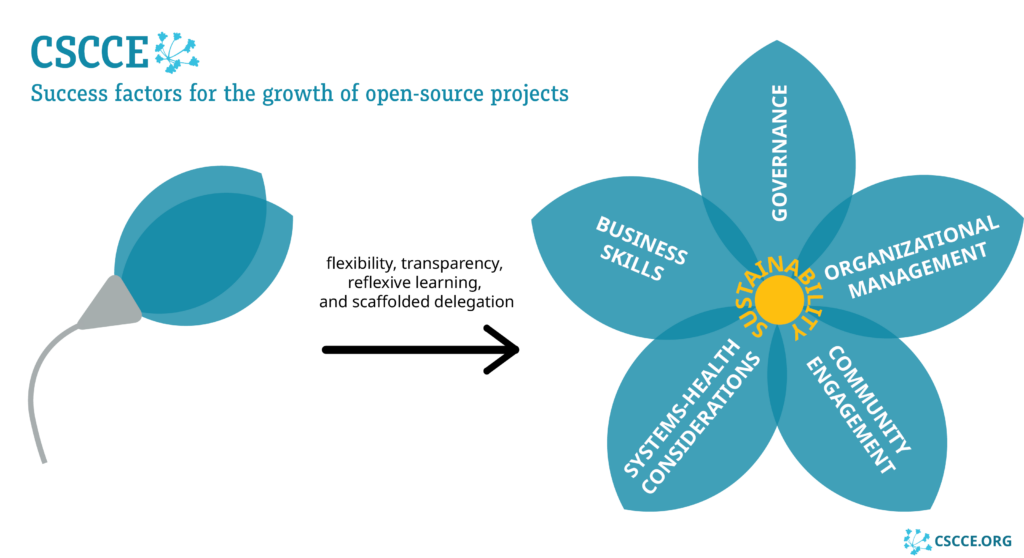
Figure 2: Our interviews revealed five interconnected themes in the growth of open-source projects: governance; organizational management; community engagement; systems-health considerations; and business skills. The path to sustainability is catalyzed by flexibility, transparency, reflexive learning, and scaffolded delegation. Note that different projects may weigh the importance of each petal differently, and be at different stages of addressing each petal.
Other Areas of Consideration
Although the five themes are what primarily emerged from our discussions as part of this project, they are not intended to be an exhaustive list of skills or topics to consider when building a new open-source project. We welcome feedback on this initial model as one starting point for thinking about training and resource gaps and how a community of practice might support shared learning around these topic areas.