This post originally appeared on the Birdaro blog. Birdaro, which is powered by CSCCE, offers leadership development for open source projects. In 2025, we ran a pilot cohort of the Birdaro training program that focused on governance and documentation in open source. This post is one of several reflecting on the outcomes of the pilot cohort.
From September-December 2025, we worked with 24 scientific open source projects through the pilot cohort of the Birdaro training program. This multi-week training module, funded by the Chan Zuckerberg Initiative, focused on governance and documentation in open source (OS), and included training sessions facilitated by CSCCE staff and discussion forums for participants to learn from each other.
This post is the second in a 2-part series (read part 1) focusing on how the Birdaro training program supported participants in creating community playbooks – a proactive formula for curating documentation and making it available (and usable!) to the audiences who need it. If you haven’t read the first post already, we suggest you take a read to gain some more context about Birdaro, playbooks, and the different ways they can positively impact OS projects.

CIB Mango Tree: A playbook to encourage contributions from more individuals
Playbook type: Contributor guide
Audience: New and existing (but relatively inactive) contributors
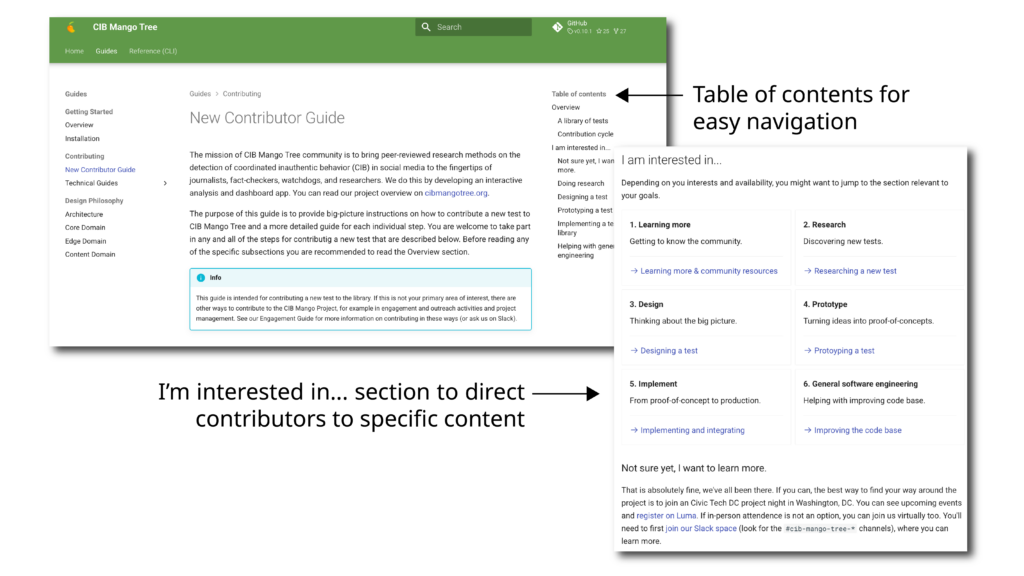
Notable features: The structure of this playbook is particularly helpful for engaging contributors via an “I’m interested in…” menu that clearly signposts how people with different areas of interest or expertise can get involved. The team also implemented a table of contents so that readers can easily jump around and find the content they need, rather than trying to read through all the material in a linear fashion.
CIB Mango Tree is building free and open source software programs that allow non-technical researchers to investigate large social media datasets for signs of inauthentic behavior and manipulation. Three team members participated in the PBK portion of the Birdaro training program, Cameron Peltz, Helen Glover, and Kristijan Armeni.
At the end of March 2026, Kristijan shared the news that CIB Mango Tree’s new contributor guide was live, and highlighted how the guide came together in a blog post.
“In many open source projects, the majority of contributions are authored by very few contributors. For example, looking at more than 1,000 open source repositories on GitHub, a study reported that in a large majority of projects (95%), 90% of social and code interaction was handled by less than 10% of developers….[we realized] that, as a growing project, we needed clearer processes and guidance to help contributions move forward. We needed a playbook.’ – Kristijan Armeni
During their time in the Birdaro training program, the CIB Mango Tree team identified two main goals for their new playbook:
- Break down the contribution cycle into smaller steps and explicitly spell out the goals for each step
- Clearly outline hand-offs for each step
The result was a “New Contributor Guide” that curated all of the information a new contributor to the project would need, clear guidelines around processes and norms.
REVIEW THE PLAYBOOK: CIB Mange Tree’s New Contributor Guide
RSpace: The ultimate guide for project contributors
Playbook type: Contributor guide
Audience: All contributors to RSpace
Notable features: This playbook exists as a GitHub repo in the RSpace Project, an environment that’s familiar and easy to navigate for code contributors. The directory makes it clear where different items are and how to engage with them, and the playbook also codifies some of their governance, and includes information about upcoming community events.
RSpace solves the critical problem of fragmented research data management by providing an open-source platform that enables FAIR (Findable, Accessible, Interoperable, Reusable) data workflows across the entire research lifecycle, from planning to publication. Two of their team members, Tilo Mathes and Rory MacNeil, participated in the program.
In April 2026, RSpace published “The Guide to the RSpace Project,” a comprehensive community playbook that Tilo began creating during the Birdaro training project.
“The Guide covers contribution paths for code, documentation, UX, and integrations; how decisions get made; and how to get in touch. It lives in our community repository alongside our office hours archive, UX research, and community project listings. [The Birdaro Training Program] helped us think more carefully about who we’re building this community for and why.” – RSpace on LinkedIn
RSpace’s guide is intended to be a living community resource, with contributors continuing to improve and add to it over time.
REVIEW THE PLAYBOOK: The Guide to the RSpace Project

Dataverse: Creating multiple playbooks for different audiences
Playbook types: Contributor guide AND a Decision-maker guide
Audience: Contributors to Dataverse and stakeholders in scaling the growth of the Dataverse community
Notable features: Dataverse’s team is highly community-engaged, and their approach to developing new documentation via a working group exemplifies this. The team also identified a need for multiple playbooks, and after clearly defining their audiences they’re now making progress towards creating them.
The Dataverse Project is an open source web application to share, preserve, cite, explore, and analyze research data. Team members Philipp Conzett and Ceilyn Boyd participated in Birdaro, and began developing not one but two playbooks for their project.
At their March 2026 community call, Philipp and Ceilyn introduced the strategy behind their playbook design, one for Dataverse community members (which includes contributors and users of the software) and one for decision-makers intended to support scaling the Dataverse community.
They’ve now established a “documentation working group” to continue the work they started in the Birdaro training program, which will meet in person at Dataverse’s May 2026 meeting in Barcelona. A working group is one way to plan intentionally for the maintenance and expansion of a playbook – something we covered during the course so that all of the hard work of the teams would be actively built upon
WATCH PHILIPP AND CEILYN TALK ABOUT THEIR NASCENT PLAYBOOKS: March 2026 Dataverse Community Call

Creating community playbooks as a “documentation debt” solution for open source projects
As we discussed in part 1 of this blog post, documentation debt is a persistent and urgent challenge software engineers face (especially with the increasing involvement of AI), as solutions are coded and implemented faster than a team can write them down. And for open source projects, the challenge is even more acute: it’s not just a small team of engineers working on a project, it’s a broad community of volunteers.
We’re heartened to share some of the real impacts CSCCE’s training in community playbook development is having on the projects who took part in the pilot cohort of the Birdaro training program. We’re actively seeking partners and funding both to continue to deliver the governance and documentation module and to create additional modules.