Introduction – The Community Manager’s Survival Guide: Building Social Capital in Large, Heterogeneous, Geographically Dispersed Research Networks

We’re continuing to share reflections from the 2017 Community Engagement Fellows on the blog. In today’s post, Andy Leidolf introduces his four part series, “The Community Manager’s Survival Guide: Building … Continue reading “Introduction – The Community Manager’s Survival Guide: Building Social Capital in Large, Heterogeneous, Geographically Dispersed Research Networks”

We’re continuing to share reflections from the 2017 Community Engagement Fellows on the blog. In today’s post, Andy Leidolf introduces his four part series, “The Community Manager’s Survival Guide: Building Social Capital in Large, Heterogeneous, Geographically Dispersed Research Networks.” You can catch up on all posts by the Fellows here.

Posted by Andy Leidolf, Coordinator, Honors Program, Utah State University, and Executive Director, Society for Freshwater Science. Leidolf served as iUTAH Assistant Director and Project Administrator from 2014-2018.

It’s Monday morning, 9 am. I am fresh off a two-week trip that seemed like a great idea when it was conceived three months ago. Confronted with the stark reality of my overflowing e-mail inbox, endless to-do lists spread across no less than three project management software applications, and the surly looks with which I am greeted by my co-workers, that axiom clearly no longer holds. In exactly four weeks, iUTAH EPSCoR will hold its last Annual Symposium and Summer All-hands Meeting, to cap off a successful 5-year run of advancing water science, training, education and outreach for the citizens of the state of Utah. And I am way behind.

I need to recruit people to introduce five invited talks of participants sharing their personal journeys with our project. I need to confirm 39 oral presentations spread among seven concurrent sessions. I need seven session chairs and one panel moderator. I need to sweet-talk/coerce/beg contacts at ten state institutions of higher education into convincing their top-level administrators to record a short video message congratulating iUTAH on its successes. I need to breathe. I need help. Fast.
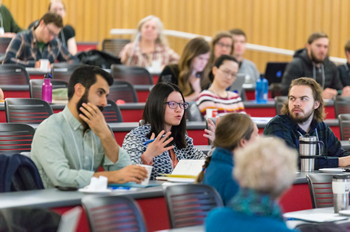
Broader Impacts forum and workshops on March 31 in Salt Lake City UT. Credit: UU Office of Undergraduate Research

Continue reading “Introduction – The Community Manager’s Survival Guide: Building Social Capital in Large, Heterogeneous, Geographically Dispersed Research Networks”

Resource rabbit hole: Part I

Today we continue our series of regular posts for science community managers interested in diversity, equity and inclusion. This installment was authored by Josh Knackert, UW-Madison Neuroscience Training Program. Additional series … Continue reading “Resource rabbit hole: Part I”

Today we continue our series of regular posts for science community managers interested in diversity, equity and inclusion. This installment was authored by Josh Knackert, UW-Madison Neuroscience Training Program.

Additional series coordinators are Jennifer Davison, Urban@UW, University of Washington, Marsha Lucas, Society for Developmental Biology and Rosanna Volchok, The New York Academy of Sciences. You can find all of the posts in the series here.

Through our roles as community managers, and especially during our preparation for this series, we came across lots of great resources, examples, and tools. We will intermittently highlight these in a recurring segment we’re calling the Resource Rabbit Hole. While our posts are never meant to be a deep dive, we certainly like to encourage readers and collaborators to learn as much as they can about these topics. We hope these posts will help you delve further into areas that you find especially interesting. Also, feel free to share your favorite resources with us at info@www.cscce.org.

What resources have you found useful? Image Credit: https://www.geograph.org.uk/photo/5307228
What resources have you found useful?
Image Credit: https://www.geograph.org.uk/photo/5307228
Continue reading “Resource rabbit hole: Part I”

Fostering diversity as a community manager: Series introduction

Today we launch a brand new series of regular posts on the Trellis blog for scientific community managers interested in diversity, equity and inclusion. This installment was authored by Josh Knackert, UW-Madison … Continue reading “Fostering diversity as a community manager: Series introduction”

Today we launch a brand new series of regular posts on the Trellis blog for scientific community managers interested in diversity, equity and inclusion. This installment was authored by Josh Knackert, UW-Madison Neuroscience Training Program. Additional series coordinators are Jennifer Davison, Urban@UW, University of Washington, Marsha Lucas, Society for Developmental Biology and Rosanna Volchok, The New York Academy of Sciences. You can find all of the posts in the series here.

Why does diversity, equity, and inclusion matter in communities?

“Welcoming and supporting a broad range of backgrounds, skills, perspectives, and approaches helps communities be most effective.”

Community can mean different things for different people – a collection of individuals with a shared purpose, small efforts driving a larger movement, or a support structure, to name a few. Key principles at the heart of all of these definitions are diversity, equity and inclusion.  Welcoming and supporting a broad range of backgrounds, skills, perspectives, and approaches helps communities be most effective.

Hands up for diversity, equity and inclusion! Image credit: https://www.flickr.com/photos/wocintechchat/25388901994/
Hands up for diversity, equity and inclusion!
Image credit: https://www.flickr.com/photos/wocintechchat/25388901994/
Continue reading “Fostering diversity as a community manager: Series introduction”